
Introduction
A line of stitching is one of the most visible signatures of leather craftsmanship. It can appear simple: a sequence of evenly spaced marks following an edge. Yet a durable seam is not created by appearance alone. Its performance depends on decisions that are largely invisible once the object is finished.
Thread type, stitch length, hole geometry, distance from the edge, leather thickness, seam allowance, tension, backing material, and the direction of stress all influence how a stitched component behaves through years of opening, folding, carrying, and handling.
At Maison Viven, the more useful question is therefore not whether a stitch looks handmade or machine-made. It is whether the entire seam has been designed and executed for the work the object is expected to perform.
A Stitch Is a Structural Decision
Decorative stitching can be judged primarily by appearance. Structural stitching cannot. On a wallet, repeated flexing concentrates stress around folds and pocket openings. On a travel bag, handles and shoulder-strap attachments must transfer far greater loads into the surrounding material. The stitch pattern has to respond to those forces.
A seam positioned too close to an edge may leave too little leather to resist tearing. Move it too far inward and the construction can become visually heavy or create unnecessary bulk. Good placement balances strength, proportion, and the geometry of the component.

Stitch Length Changes Both Appearance and Performance
Stitch length is often discussed as an aesthetic preference, but density has mechanical consequences. Very long stitches can appear coarse and may provide insufficient control in small components. Extremely short stitches create more perforations in the leather and, when poorly judged, can weaken a narrow edge rather than strengthen it.
The appropriate rhythm depends on leather thickness, thread diameter, seam location, curvature, and expected stress. A refined result is not achieved by selecting the smallest possible stitch. It comes from choosing a proportion that suits the material and the scale of the object.
Thread Must Be Chosen for the Seam
Thread is a small component carrying a disproportionate responsibility. It must withstand repeated tension, abrasion, flexing, and environmental exposure while remaining compatible with the leather around it.
Thickness matters visually and structurally. Thread that is unnecessarily heavy can dominate a refined small leather good. Thread that is too fine may lack the durability required in a high-stress attachment. Fiber, twist, surface treatment, and colorfastness also affect long-term behavior.
The best thread is therefore not simply the most expensive or conspicuous. It is the one whose strength, diameter, finish, and appearance are appropriate to the seam it is asked to hold.

Tension Should Hold, Not Distort
Evenly spaced stitches can still produce a poor seam when tension is incorrect. Excessive tension may pull the leather inward, create puckering, exaggerate perforations, or distort a thin component. Insufficient tension can leave the seam loose and allow layers to move against one another.
Proper tension draws the components together without forcing them out of shape. The seam should appear settled rather than strained. On layered leather, this requires particular control because different materials and thicknesses can compress at different rates.

Corners Reveal the Quality of the Planning
Straight stitching is comparatively forgiving. Corners, curves, pocket ends, and transitions expose whether the stitch path was planned as part of the design.
A poorly resolved corner may contain an awkward half-stitch, inconsistent spacing, excessive perforation, or a stitch that lands too close to the edge. A well-resolved corner maintains rhythm while respecting the geometry and stress of the component.
This is why pattern development and stitching cannot be treated as separate disciplines. Hole placement, seam allowance, corner radius, and finished dimensions must be considered together before the final object is assembled.

Hand Stitching and Machine Stitching Serve Different Purposes
Hand stitching is often presented as inherently superior to machine stitching. That is too simple. Each method has advantages, and quality depends on the appropriateness of the method and the standard of execution.
Traditional saddle stitching can create a highly durable seam and gives the craftsperson direct control over each stitch. Well-selected industrial machinery can deliver exceptional consistency, speed, and repeatability, particularly on long seams and components engineered for production.
The meaningful distinction is not hand versus machine. It is considered construction versus careless construction. A method should be chosen because it serves the material, design, production standard, and intended use.

The Seam Must Work With the Edge
Stitching does not exist independently from edge construction. Folded edges, raw edges, painted edges, turned seams, and layered components each place the stitch in a different relationship with the material.
On a painted edge, the preparation beneath the coating matters as much as the visible finish. Layers must remain aligned, the stitch line must follow the geometry cleanly, and sufficient material must remain between the perforations and the edge. A beautiful edge cannot compensate for a structurally weak seam.

Inspection Begins Before the Final Stitch
Stitch quality cannot be inspected only at the end. By final assembly, many of the decisions that determine seam performance are already fixed.
Patterns should establish repeatable stitch paths. Materials should be tested at representative thicknesses. Samples should be flexed and handled. High-stress areas should be reinforced appropriately. During production, stitch consistency, skipped stitches, thread condition, tension, back-tacking or termination, edge distance, and surface marks all require attention.
Final inspection confirms the result, but process control creates it.

The Maison Viven Perspective
Precision Should Become Quiet
The best stitching does not ask the owner to admire every perforation. Its purpose is quieter. It holds layers in the correct relationship, follows the proportions of the object, survives repeated movement, and allows the surface to age without the construction losing integrity.
When those decisions are resolved properly, the seam becomes almost effortless to the eye. That apparent simplicity is not the absence of work. It is evidence that the work has been considered.
For Maison Viven, craftsmanship is found in that discipline: technical decisions made carefully enough that the finished object can simply perform.

“A refined seam should be noticed for its proportion, then forgotten for its reliability.” — Maison Viven
Frequently Asked Questions
What makes leather stitching high quality?
High-quality stitching combines appropriate thread, consistent spacing, controlled tension, correct edge distance, secure termination, and placement suited to the material and the stresses of use.
Is hand stitching always stronger than machine stitching?
No. Traditional saddle stitching can be extremely durable, but well-executed machine stitching can also provide excellent strength and consistency. The correct method depends on the product, seam design, materials, and intended use.
Are smaller stitches always better on leather goods?
No. Excessively short stitch lengths create more perforations and can weaken narrow or delicate areas. Stitch length should be proportionate to the leather thickness, thread, geometry, and expected stress.
Why does stitch distance from the edge matter?
The stitch line needs enough material outside the perforations to resist tearing while remaining visually proportionate to the component. Placement that is too close to an edge can reduce strength.
What causes leather to pucker around stitching?
Puckering can result from excessive thread tension, incompatible material thicknesses, poor feeding during sewing, or insufficient control of layered components.
What is saddle stitching?
Saddle stitching is a traditional hand-sewing method in which two needles pass a thread through the same sequence of holes from opposite sides, creating an interlocking seam without relying on a machine lockstitch.
How can a customer judge stitching quality?
Look for consistent spacing, smooth tension, clean corners and curves, secure seam endings, appropriate thread proportion, an even distance from the edge, and leather that lies naturally without distortion.


A journey begins before the door closes. Explore how the quiet ritual of preparing to leave can clarify what we need, what we carry, and what deserves to come with us.Meta Description: Explore the ...
Read more
The Quiet Discipline of Buying Less, Better
Buying less, better is a discipline of selection. Explore how purpose, quality, restraint, care, and time can lead to fewer, more enduring possessions
Read more
The Objects that Earn a Place in Our Lives
Why do some possessions become indispensable while others are quickly replaced? Maison Viven explores usefulness, familiarity, quality, patina, and the value of objects made to be kept.
Read more
How to Recognize Quality Leather
Learn how to evaluate quality leather by understanding grain, finish, feel, construction, and aging—and why no single label, price, or country of origin tells the whole story.
Read more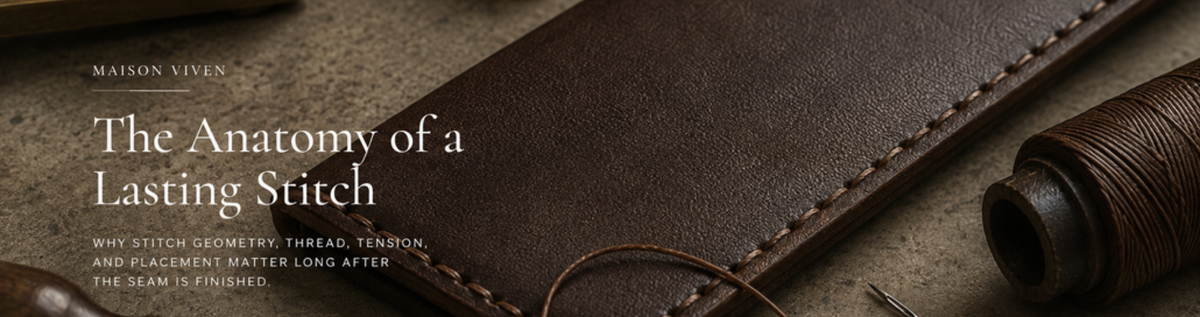
The Anatomy of a Lasting Stitch
Discover how stitch length, thread, tension, edge distance, and seam geometry influence the durability and refinement of well-made leather goods.
Read more
The Architecture of a Well-Made Object
Discover the hidden architecture of well-made leather goods—from reinforcement and skiving to lining, hardware, and structure designed for years of use.
Read more