
Introduction
A wallet is an everyday decision disguised as a small accessory. You reach for it at a café, at an airport, in a shop, or on an ordinary afternoon. The right one should make those moments easier without demanding attention.
Two familiar formats offer different advantages: the traditional bifold wallet and the slimmer card holder. Neither is inherently more refined, more practical, or more appropriate for everyone. Their value depends on how much you carry, how you access it, and where the object lives throughout your day.
Before choosing, consider your habits rather than a trend. The following guide explains the differences, the trade-offs, and the details worth examining.
If you would like to explore what makes a well-made wallet, from leather selection to stitching and construction, read our guide, How to Choose a Leather Wallet That Lasts.
What Is the Difference Between a Bifold Wallet and a Card Holder?
A bifold wallet folds in half and typically combines card slots with a compartment for banknotes. Its layout separates and organizes different essentials while keeping them together in one object.
A card holder is usually more compact. It focuses on access to a smaller number of cards, sometimes with an additional pocket for folded notes or receipts. Its reduced footprint can make it particularly convenient for lighter carry.
The difference is not simply size. It is how each design distributes capacity, access, thickness, and comfort.
| Consideration | Bifold Wallet | Card Holder |
|---|---|---|
| Primary purpose | Cards and banknotes in one organized format | Compact access to essential cards |
| Typical capacity | Often more cards and unfolded notes | Usually fewer cards; notes may need folding |
| Pocket profile | Can be thicker when filled | Often slimmer when lightly loaded |
| Organization | Dedicated sections for different contents | Simpler arrangement and fewer compartments |
| Best fit | People who regularly carry cash and multiple cards | People who prefer a reduced everyday load |
| Main trade-off | Greater capacity can create bulk | Less capacity can require compromises |
These are general design tendencies, not guarantees. The dimensions and performance of any particular wallet depend on its construction and contents.
1. Begin With What You Actually Carry
Empty your current wallet and look at what is inside. Which cards do you use every week? Which have not been touched in months? Do you regularly carry cash, receipts, identification, or a transit card?
If you routinely carry banknotes and several cards, a bifold may provide the more natural arrangement. If you primarily use a small group of cards, a card holder may eliminate compartments you do not need.
Do not choose by maximum capacity alone. A wallet that encourages you to carry everything can become less comfortable, while a card holder filled beyond its intended capacity may become difficult to use.
2. Consider Pocket Comfort, Not Just Dimensions
A wallet should be evaluated when loaded, not merely when photographed empty. Card thickness, folded notes, leather layers, reinforcement, and pocket construction all contribute to the final profile.
Consider whether you carry your wallet in a front trouser pocket, jacket pocket, or bag. A compact card holder may suit fitted clothing and short outings. A bifold may remain comfortable when its proportions and leather flexibility are well judged.
The useful test is simple: load the items you normally carry, sit down, walk, and retrieve a card. Comfort is a functional quality, not an aesthetic claim.
 Judge a wallet by the way it carries, not only by the way it looks.
3. Access and Organization Matter
A bifold can make it easier to separate banknotes from cards, and personal cards from business or travel essentials. Its additional compartments may be useful for someone who prefers a familiar, structured layout.
A card holder favors simplicity. With fewer pockets, the cards you carry may be immediately visible and accessible. That advantage disappears, however, if the holder is packed too tightly or its pockets are difficult to use.
Look for secure retention without excessive resistance. Cards should slide in and out with reasonable ease and remain held during normal handling. A well-designed wallet balances accessibility with security.
4. Examine the Leather and Construction
The choice between bifold and card holder does not determine quality. Either format can be made exceptionally well or poorly. Evaluate the leather, stitching, edges, pocket alignment, fold construction, lining, and how the layers come together.
Full-grain leather describes a retained outer grain surface, but the term alone does not establish suitability or durability. Leather may also be finished or embossed. Surface uniformity is not a reliable shortcut for judging quality.
Look at the inside as closely as the outside. Are the card openings clean? Are the edges consistently finished? Does the bifold flex naturally? Are there loose threads or uneven layers? These details often reveal more than a prominent logo.
For a deeper material discussion, our Journal article How to Recognize Quality Leather explains the terminology and the limitations of visual inspection. The Anatomy of a Lasting Stitch explores why seam execution matters.
 Construction should support the way an object is used.
5. Think About Travel and Everyday Routine
Your ideal wallet may change with the occasion. A card holder can be convenient for a short outing when only a payment card and identification are needed. A bifold may be preferable when traveling with banknotes or a wider range of cards.
Some people find one format suitable for nearly everything. Others use a primary wallet and occasionally carry a smaller card holder. Neither approach is inherently more intentional. The question is whether each object has a real role.
A good travel setup should reduce friction. It should not create extra steps merely to look minimal.
6. Understand Aging and Care
Leather responds to handling, friction, light, moisture, and time. Depending on its finish, it may soften, develop tonal variation, or acquire a subtle patina. Normal changes in character are different from peeling finishes, failed seams, or damaged pocket openings.
Care requirements depend on the particular leather. Follow the maker's instructions, keep the item reasonably clean and dry, and avoid applying conditioning products indiscriminately.
The better choice is one you will enjoy using and can maintain appropriately, not necessarily the one that looks most pristine on the day of purchase.
7. Choose Value Over Novelty
A higher price does not automatically make a wallet better. Price can reflect material selection, labor, production scale, distribution, branding, and other costs. Evaluate the product against its purpose and the quality of its execution.
Ask whether the design is likely to remain useful after the excitement of a new purchase has faded. A wallet that works quietly every day may be more valuable to its owner than a more elaborate object that rarely feels right.
For a broader perspective on choosing quality over quantity, explore our Journal article, The Quiet Discipline of Buying Less, Better.
A Simple Decision Checklist
- Do I regularly carry banknotes, or mainly cards?
- How many cards do I actually use in an ordinary week?
- Will I carry the wallet in a front pocket, jacket, or bag?
- Does it remain comfortable and accessible when filled?
- Are the stitching, leather, pocket openings and edges carefully finished?
- Can I remove cards without excessive force while keeping them secure?
- Do I prefer more organization or fewer compartments?
- Am I choosing for my daily routine or for a passing trend?
The Maison Viven Perspective
Maison Viven began with a deliberately focused collection of everyday and travel essentials. The Founder Wallet and Card Holder were conceived as complementary choices, not as competing claims that one way of carrying is universally superior.
In reviewing prototypes, we pay attention to leather feel, card access, retention, thickness, comfort and the way each object behaves when used. Those observations matter more to us than an impressive specification that does not translate into everyday usefulness.
If you prefer carrying cards and notes together, a bifold may be the right companion. If you carry only the essentials, a card holder may suit you better. What matters is choosing deliberately.
 Different forms, one principle: carry what serves you.
Frequently Asked Questions
Is a bifold wallet better than a card holder?
Not universally. A bifold generally offers more organization and space for banknotes; a card holder prioritizes compactness and lighter carry. The better choice depends on your contents and habits.
Which is more comfortable in a front pocket?
A lightly loaded card holder is often more compact, but comfort depends on the design, thickness, clothing and contents. Compare the items filled as you would normally carry them.
Can a card holder replace a wallet?
Yes, for people who mainly carry a small number of cards and rarely need unfolded banknotes. Others may prefer a bifold for greater organization.
Does a bifold always last longer than a card holder?
No. Durability depends on leather, construction, stress points, use and care, not simply the format.
What should I check before buying either one online?
Review dimensions, interior photographs, intended card capacity, material and construction details, care guidance, and the seller's return policy.
Is full-grain leather automatically better for either format?
No. Full-grain is a useful material description, but tanning, finish, thickness, design and manufacturing execution also affect suitability.
Should I own both a bifold and a card holder?
Only if each serves a genuine purpose. Some people benefit from separate everyday and light-carry options; others need only one.
“The right wallet is not the one that carries the most. It is the one that carries what matters, comfortably and well.”
— Maison Viven
A journey begins before the door closes. Explore how the quiet ritual of preparing to leave can clarify what we need, what we carry, and what deserves to come with us.Meta Description: Explore the ...
Read more
The Quiet Discipline of Buying Less, Better
Buying less, better is a discipline of selection. Explore how purpose, quality, restraint, care, and time can lead to fewer, more enduring possessions
Read more
The Objects that Earn a Place in Our Lives
Why do some possessions become indispensable while others are quickly replaced? Maison Viven explores usefulness, familiarity, quality, patina, and the value of objects made to be kept.
Read more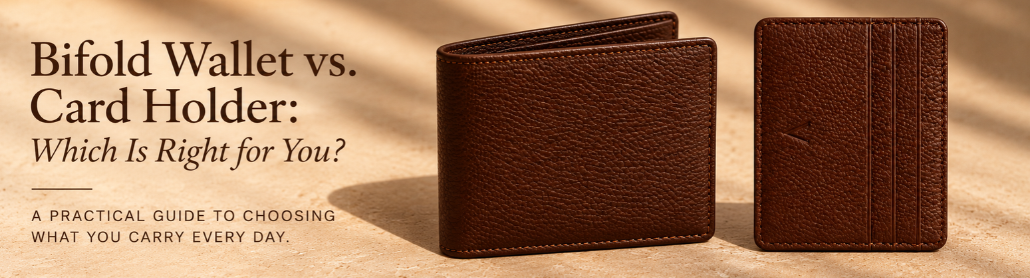
Bifold Wallet vs. Card Holder: Which Is Right for You?
Bifold wallet or card holder? A practical comparison of capacity, comfort, organization, leather construction and everyday habits to help you choose deliberately.
Read more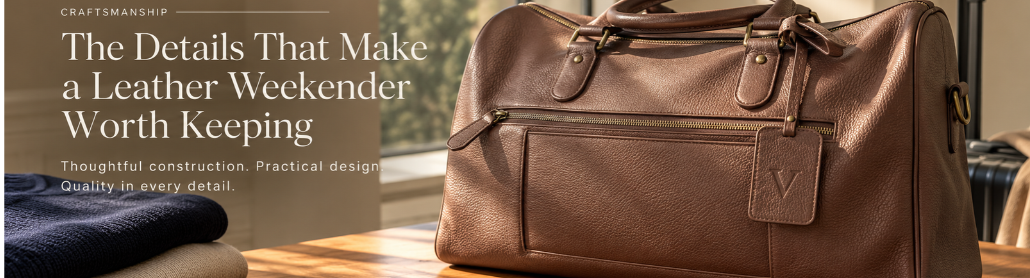
The Details That Make a Leather Weekender Worth Keeping
What makes a leather weekender worth keeping? Discover how quality leather, thoughtful construction, comfortable handles, reliable zippers, and practical design come together to create a travel bag...
Read more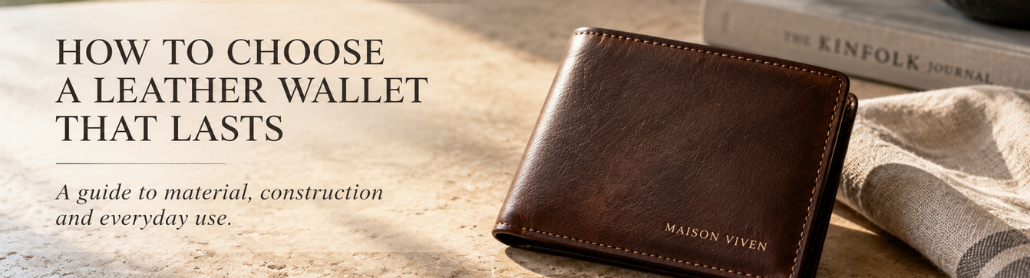
How to Choose a Leather Wallet That Lasts
A practical guide to choosing a leather wallet that suits your daily carry, with clear advice on leather types, construction, stitching, edges, comfort, patina and lasting value.
Read more